
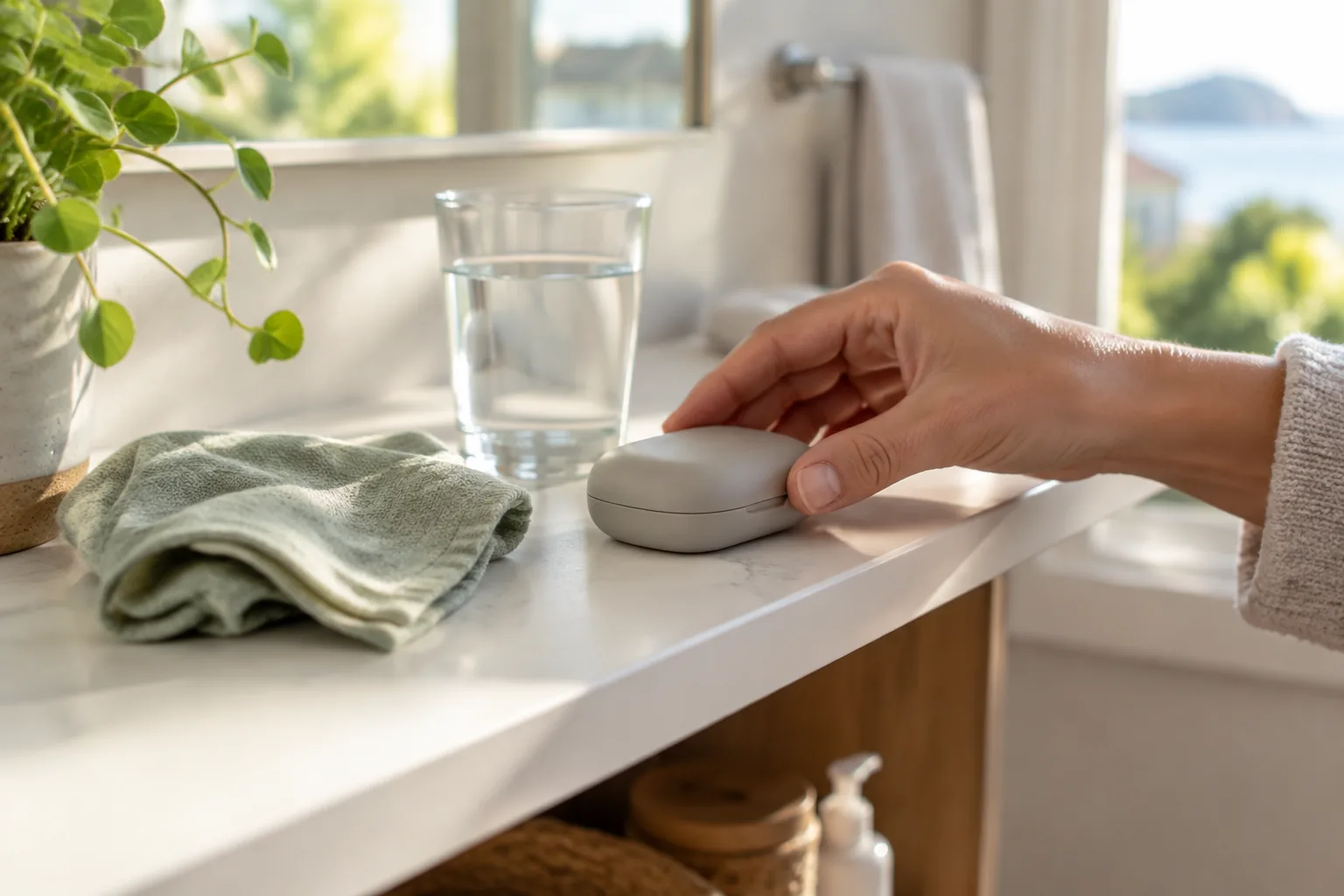
Follow the booklet that came with your hearing aids. Hearing Australia suggests wiping them daily with a cleaning cloth, with no pressure, and never using running water. Keep them dry, away from heat and sprays, and in their case when not worn. If they stop working, ask for help.
Your hearing aids sit close to your ear all day, so a little care goes a long way. This guide covers everyday wiping, moisture, storage, battery precautions and what to do when something seems wrong. It is written for adults who wear hearing aids, and it draws on Hearing Australia, Healthdirect and WA Health.
One rule sits above everything else here: follow the instructions that came with your hearing aids. Different makes and styles are built differently, and a step that suits one model may not suit another. Where this guide and your manufacturer's booklet differ, go with the booklet, or ask your audiologist.
What do hearing aids need each day?
Most daily care takes a minute or two.
- Wipe the outside. Hearing Australia says to clean your hearing aid daily with a cleaning cloth, not to apply pressure when wiping, and never to use running water or put the hearing aid in water.
- Check any tube or wire. If your hearing aid has a tube or wire, Hearing Australia says to check that it is not squashed, twisted or split.
- Look at the sound outlet. Hearing Australia lists a sound outlet blocked by wax as one thing to check when a hearing aid has no sound or weak sound. Your booklet will show how your manufacturer wants you to look after that part.
- Put them away properly. Hearing Australia advises putting your hearing aids in their case when you are not wearing them.
Hold your hearing aids over a soft surface, such as a towel, while you handle them. They are small and easy to drop.
How do you keep hearing aids dry?
Moisture is one of the main things to keep away from your hearing aids. Hearing Australia says that moisture can damage both a hearing aid and its batteries.
- Keep them out of the shower and the rain. Hearing Australia advises avoiding getting your hearing aid wet, which includes not wearing it in the shower or in the rain.
- Remove moisture gently. If a hearing aid does get damp, Hearing Australia says to remove any moisture with a tissue or dry cloth.
- Open the battery door overnight if your hearing aids use disposable batteries. Hearing Australia says that opening the door to the battery compartment when the aids are not in use, for example overnight, allows moisture to escape.
- Ask whether yours can get wet. Healthdirect suggests asking your audiologist whether your hearing aid can get wet. Some models differ, so check your booklet.
If your hearing aids stay damp or stop working after getting wet, bring them in rather than trying to repair them yourself.
Where should you store them?
- In their case. Hearing Australia advises keeping your hearing aids in the case when you are not wearing them.
- Away from heat. Hearing Australia advises not exposing your hearing aid to extreme heat.
- Away from sprays and products. Hearing Australia advises removing your hearing aids before using aftershave, hairspray, perfume, sunscreen or insect repellent, because these may contain chemicals that could damage them. Put your hearing aids in after you have finished applying them.
- Out of reach of children and pets. See the battery section below.
What about batteries?
If your hearing aids use disposable batteries, a few habits are worth knowing about. Hearing Australia says:
- Keep clean, dry hands when you handle batteries, because grease and dirt can damage both batteries and hearing aids.
- Turn your hearing aids off when you are not using them, because leaving them switched on wastes battery power.
- Leave the plastic tab on a new battery until you are ready to use it, then let the battery sit for one minute before inserting it into the compartment.
Healthdirect says to keep batteries away from children because they are dangerous if swallowed. Hearing Australia says batteries can cause severe or fatal injuries in two hours or less if swallowed or placed inside any part of the body.
If you suspect a battery has been swallowed, WA Health says to seek medical attention immediately and phone the Poisons Information Centre on 13 11 26, available 24 hours a day. In a medical emergency, dial triple zero (000). WA Health also says not to give food or drink and not to induce vomiting.
If your hearing aids are rechargeable, your booklet will explain how to charge and store them.
What should you not do?
This list is just as important as the daily steps.
- Do not use running water or put hearing aids in water. Hearing Australia is clear on this.
- Do not press hard when you wipe them. Hearing Australia says not to apply pressure.
- Do not leave them in hot places. Hearing Australia advises against exposing them to extreme heat.
- Do not wear them when applying sprays or products. Take them out first.
- Do not take them apart or try to repair them yourself. Only handle the parts your booklet says you can handle.
- Avoid putting anything in your ear. If your ear feels blocked, book an assessment instead.
What if you think your ear is blocked?
A blocked feeling can come from your ear rather than your hearing aid. Avoid putting anything in your ear and book an assessment, and your audiologist will talk through what is suitable.
If you have ear pain, discharge, dizziness, or bleeding from your ear, or your hearing changes suddenly, see your GP or go to an emergency department the same day.
What if your hearing aid is not working properly?
Some problems have simple causes. Hearing Australia's troubleshooting guide suggests these checks.
- No sound or weak sound. Check whether the device needs recharging or a new battery. Check that the sound outlet is free of wax. If you have a volume control, check it has not been turned down. If you have a program button, check it has not accidentally been changed to the telecoil program.
- Whistling. Hearing Australia says hearing aids often whistle or screech while you are putting them in or taking them out, and that this is normal, but they should not whistle once they are in. Make sure the earmould or earpiece is sitting in the right place, and check that the tubing is not cracked or torn.
- An earmould that looks discoloured or hardened. Hearing Australia says it will need replacing, which is a job for your hearing provider.
If the problem continues, contact your hearing provider. Do not keep trying different things, and do not open the device.
When should you bring your hearing aids in?
Bring them in if:
- they are not working after you have run the checks above
- they have been through water or are still damp
- the whistling or poor sound continues
- a tube, earmould or other part is cracked, loose or damaged
- a battery is running out much faster than usual (Hearing Australia says this can be a sign a hearing aid needs repair)
- you notice a change in your hearing or in how your hearing aids sound
Hearing aid servicing, repairs and cleaning are on our list of services; ask us what that covers.
Should you bring your own hearing aids to an appointment?
Yes, bring them along, including the case, charger and any paperwork. If you are not sure which model you wear, the paperwork helps your audiologist look at the right instructions.
Ready to talk it through?
If you would like to talk it through, book a hearing assessment with Erin at Hearing Help (Newport Marketplace). Erin has over 25 years as an audiologist, 17 of them serving the Redcliffe area. You can book online at www.hearinghelpredcliffe.com.au/booking-form/ or call 07 3214 3641.
Frequently asked questions
How often should I clean my hearing aids?
Hearing Australia says to clean your hearing aid daily with a cleaning cloth, without applying pressure. For anything beyond wiping the outside, follow your manufacturer's instructions.
Can I clean my hearing aids with water?
No. Hearing Australia says never to use running water or immerse a hearing aid in water. Check your booklet if you are unsure about your model.
What should I do if my hearing aids get wet?
Hearing Australia says to remove any moisture with a tissue or dry cloth. If they do not work normally afterwards, bring them in.
Why do my hearing aids whistle?
Hearing Australia says whistling while putting them in or taking them out is normal, but they should not whistle once in. Check that the earmould or earpiece is sitting in the right place, and if the whistling continues, contact your hearing provider.
What should I do if a battery is swallowed?
Seek medical attention immediately and phone the Poisons Information Centre on 13 11 26 (WA Health). In a medical emergency, dial 000.
Does Hearing Help fit hearing aids for children?
No. Hearing aid fittings at Hearing Help are for adults.