
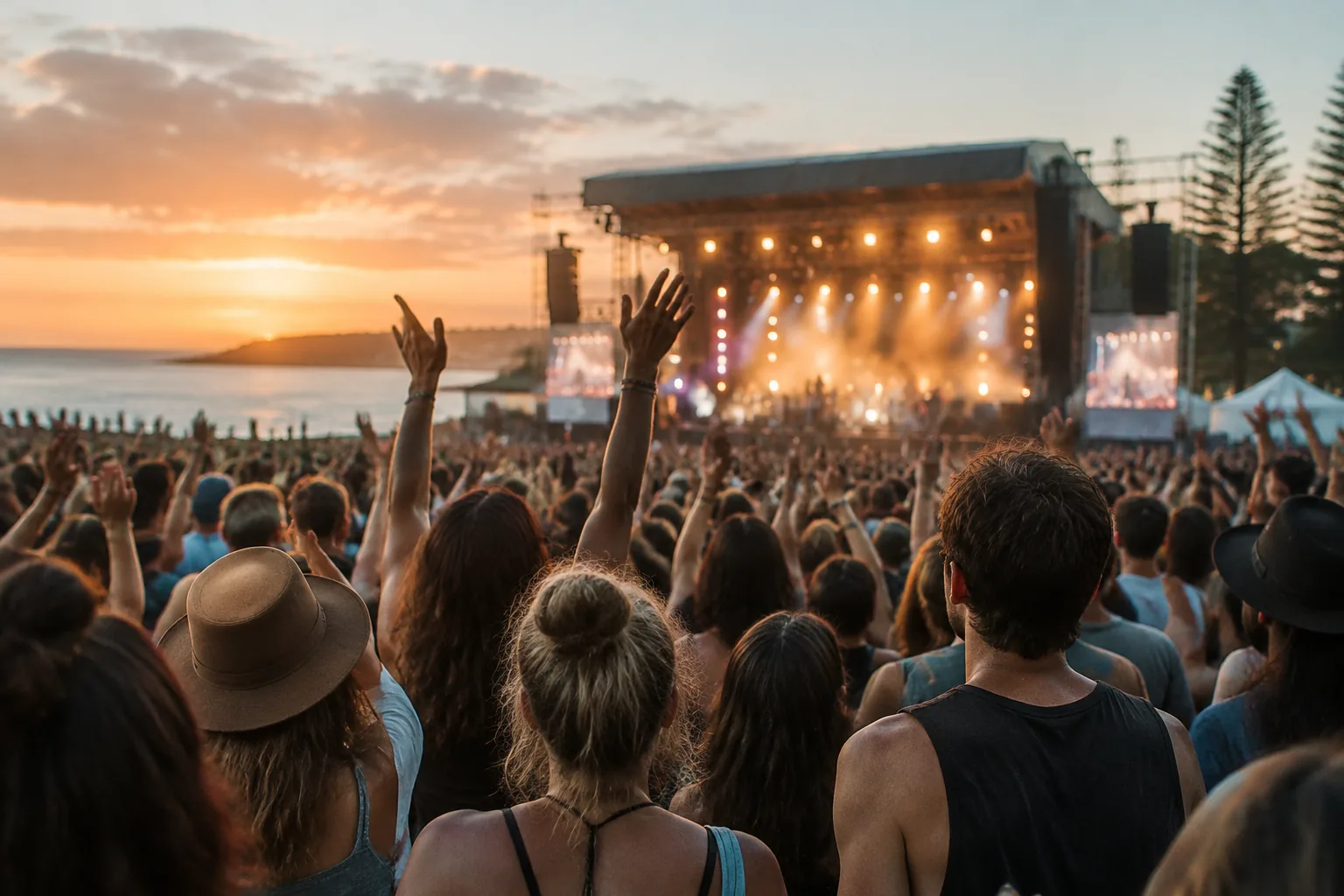
A great night out is often a loud one. The crowd roars at the footy, the bass thumps at a concert, engines scream down the straight and the fireworks go off right above you. Nobody wants to be the person who turns up with a lecture, so this guide is the opposite: a few practical facts, and a few simple options, so you can enjoy the event and look after your ears at the same time.
Why loudness and time both matter
Hearing Australia explains that the risk comes from sounds that are too loud, heard for too long, or both. It also describes a "daily sound dose": your work, home and leisure sounds all add up.
That means one loud night is part of a bigger picture. A person who works with noisy equipment all week and then heads to a concert is adding to the same total.
What do the Australian numbers say?
Australia has an official workplace noise standard, set out in the Work Health and Safety Regulations and explained by Safe Work Australia. It has two parts:
- an average of 85 decibels (A-weighted, written dB(A)) over an eight-hour working day
- a peak level of 140 decibels (C-weighted, written dB(C)) for sudden, very loud sounds
The same Safe Work Australia Code of Practice shows that louder noise reaches that same exposure sooner. For example, 85 dB(A) for eight hours delivers the same noise energy as 88 dB(A) for four hours. In other words, every few decibels of extra loudness shortens the time that fits within the standard.
Two caveats. First, this standard was written for workplaces, not for people at a concert, so it is a useful reference point rather than a rule for your weekend. Second, Safe Work Australia notes that the standard protects most people but not everyone, which is why it recommends keeping noise lower where practical.
The peak level is aimed at sudden, impulsive sounds rather than steady noise.
How loud is an event, really?
This is hard to pin down, because it depends on the venue, the event and where you stand. The Australian Government's Protecting your hearing fact sheet gives two examples. It lists music at a concert at 103 decibels, with a length of time you can listen without protection of less than 8 minutes, and music through earphones at maximum volume at 106 decibels, with less than 4 minutes. It also lists riding a motorcycle at 97 decibels (30 minutes) and using an electric drill at 94 decibels (1 hour).
If you want a personal estimate, the National Acoustic Laboratories (the research arm of Hearing Australia) runs the Know Your Noise website with a Noise Risk Calculator. You enter your work and leisure activities and it estimates your risk from noise exposure.
Event by event
Concerts and festivals. Hearing Australia notes that live music, loud clubs and gyms carry a higher risk, and suggests earplugs where loud music is unavoidable. Standing near the speakers adds to the exposure, so where you stand matters as well as what you wear.
Motorsport. Hearing Australia lists motor sports among the higher-risk leisure activities, so a day at the track is worth planning for.
Sport. Crowd noise varies with the event and where you sit. The general advice is the same: the louder the sound and the longer you are exposed, the greater the risk, and earplugs are one option.
Fireworks. The same general advice applies: Hearing Australia suggests keeping your distance from the source of loud sound, and earplugs are another option.
Shooting. Hearing Australia says shooters face extremely high sound levels and should wear hearing protection at all times.
Earplug options
Hearing Australia suggests three types for loud music, and the same ideas carry over to other events:
- Disposable foam earplugs. Widely available. Fit them the way the pack instructs.
- Silicone putty plugs. Again, follow the pack instructions for fitting.
- Reusable earplugs designed for music. Hearing Australia points to reusable plugs made for listening to music as an option, so ask for one designed for that purpose.
Whatever you choose, a plug only works if you wear it properly and keep it in for the whole time you are in the noise. Taking one out "just for the main act" reduces the protection you chose it for.
Custom hearing protection
Some people prefer earplugs made specifically for their ears. Hearing Help provides custom ear plugs and hearing protection. When you book, ask us how it works and whether it suits what you do.
Custom protection is one option among several. For many occasional events, a standard earplug from the pack may be all you want.
Please do not put anything in your ear to get a better fit. If a plug is uncomfortable or does not seem to fit, book an appointment so someone can look at it with you.
Practical tips for the day
- Pack earplugs before you leave. The ones you left in the car do not help.
- Think about where you stand. Sound is generally lower further from the speakers or the track.
- Take breaks. Step outside or to a quieter spot for a while if you can.
- Check the volume you control. The Australian Government's fact sheet says you should be able to easily understand someone talking to you from one metre away. Hearing Australia notes that headphones at loud volumes for long periods can also put your hearing at risk, and suggests listening at no more than 60 per cent of maximum volume for no longer than 60 minutes at a time.
When something does not feel right
If you notice a gradual change in your hearing, or you simply have a question about how you are hearing, book a hearing assessment so we can talk it through. Tinnitus assessments and support are also available at Hearing Help.
If your hearing changes suddenly, or you have sudden ringing in the ears, ear pain, discharge, bleeding or dizziness, see your GP or go to an emergency department the same day.
Keep the fun, mind the volume
You do not have to give up live music, the footy or the fireworks. A few small habits, and the right plug for the occasion, are enough for most outings.
If you'd like to talk it through, book a hearing assessment with Erin at Hearing Help (Newport Marketplace). We can talk about your hearing and the events you enjoy.