
Looking for a hearing test and you live in Rothwell? Hearing Help is an independent audiology clinic serving adults throughout the Moreton Bay region and Redcliffe Peninsula, with a commitment to thorough, unhurried, and genuinely informative hearing care.
Why People Often Wait — and Why It Is Worth Not Waiting
The most common response when we ask people why they delayed booking a hearing assessment is some version of "I wasn't sure it was bad enough yet." This is understandable. Hearing loss typically develops slowly, and humans adapt. You start sitting closer to the speaker, face people more directly, ask for repeats with a light touch — and you accommodate the change without necessarily noticing that you have.
The difficulty with waiting is that the longer a hearing loss is unaddressed, the fewer clear comparisons you have for what you were missing. An early assessment, even if results show normal hearing, gives you a documented baseline. And if some degree of loss is found, earlier identification generally means more options and more time to adapt thoughtfully.
For Rothwell residents wondering whether it is worth the effort — the answer, in our experience, is almost always yes.
What Your Hearing Assessment Will Include
A comprehensive hearing assessment at Hearing Help is a structured evaluation designed to give you a complete picture of your hearing health. The appointment typically runs between 60 and 90 minutes.
Personal hearing history. Your audiologist begins with a thorough conversation — not a quick intake form. You will be asked about occupational noise exposure, military service or use of firearms, hobbies involving noise, ear health history, any current medications, and the specific listening environments where you notice difficulty. This information is essential for interpreting what the tests show.
Otoscopic examination. Both ears are examined with a handheld lighted instrument before any hearing tests begin. This step identifies wax build-up, signs of infection or inflammation, eardrum perforations, or other findings that are clinically relevant.
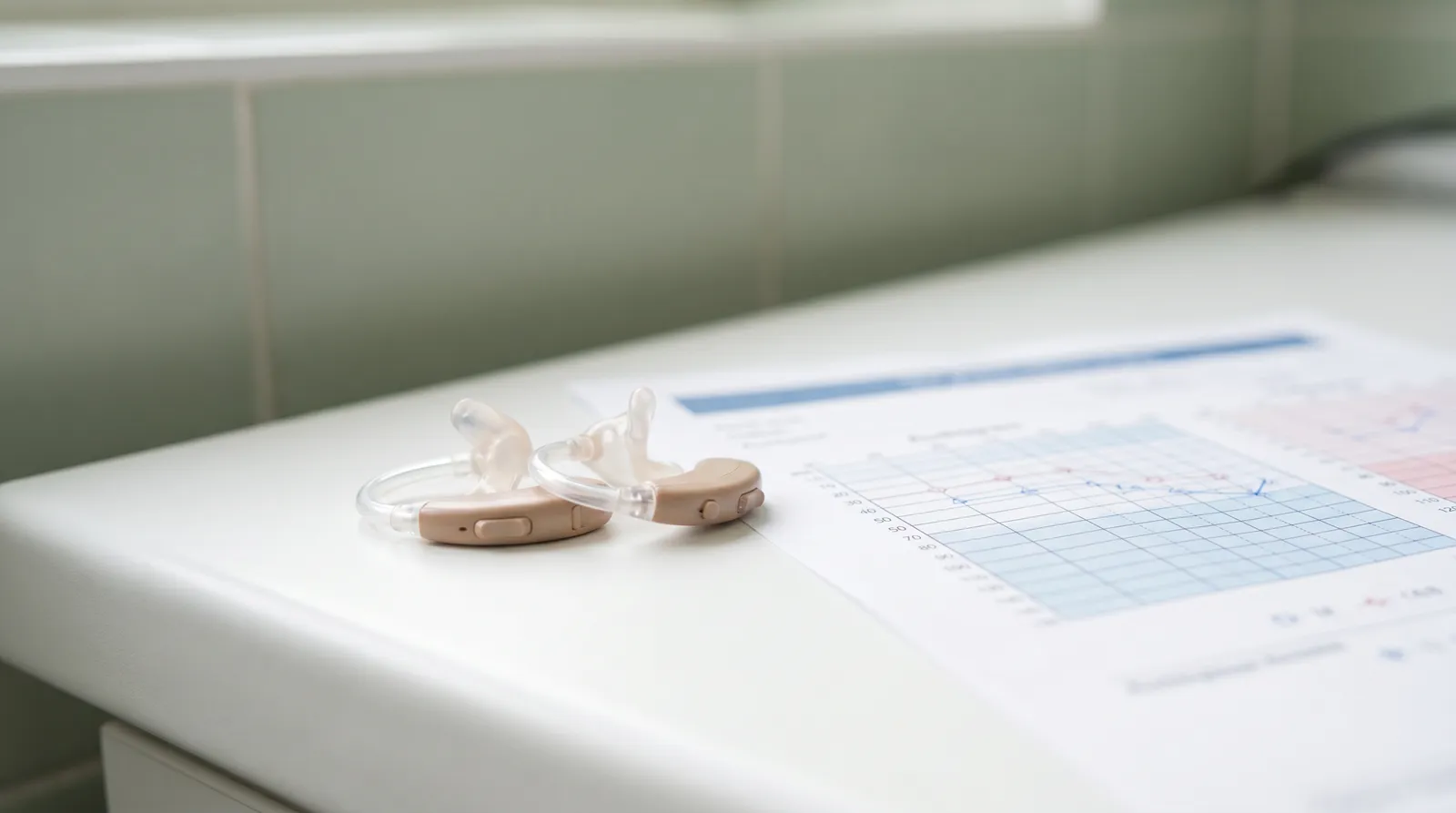
Air conduction audiometry. Headphones, a quiet room, and a series of tones at different pitches and volumes. You respond each time you hear a tone, and your responses allow the audiologist to determine your hearing threshold at each frequency. The result is your audiogram.
Bone conduction audiometry. A bone vibrator placed behind the ear tests your cochlear response independently. Comparing these thresholds with your air conduction thresholds helps classify any hearing loss as sensorineural, conductive, or mixed — an important distinction for planning.
Speech recognition testing. Words are presented at a comfortable volume, and you repeat them back. The percentage you identify correctly reflects your speech discrimination ability — the hearing ability most relevant to everyday conversation.
Tympanometry. A brief, comfortable middle ear function test that assesses how well your eardrum moves and whether the middle ear pressure is within normal limits.
Results explanation. Everything is reviewed with you at the end of the appointment. The audiologist explains the audiogram in plain language, discusses what the findings mean for your daily life, and outlines any recommended next steps. There is no rush and no expectation of an immediate decision.
Noise-Induced Hearing Loss: A Note for Rothwell Residents
The Moreton Bay region has a strong workforce history in industries that carry elevated noise exposure risk — construction, transport, trades, and manufacturing among them. Noise-induced hearing loss is one of the most common types of adult hearing loss in Australia, and it is entirely preventable with appropriate protection.
The problem is that noise-induced loss typically affects the higher frequency range first — the frequencies responsible for clarity in speech — before people notice significant difficulty. Many adults with measurable high-frequency hearing loss do not notice it in quiet one-on-one conversations, but struggle considerably in background noise or when listening to higher-pitched voices.
If your working life has involved significant noise exposure, a hearing assessment is a sensible and proactive step regardless of whether you currently notice difficulty.
Australian Government Hearing Services Program
The Hearing Services Program is a Commonwealth-funded initiative that provides eligible Australians with access to professional hearing assessments and, where clinically appropriate, subsidised hearing devices. Conditions apply under the Australian Government Hearing Services Program.
Eligible individuals generally include those who hold a Pensioner Concession Card, a DVA Gold Card, or a DVA White Card (for hearing-related conditions). Some other concession card holders and individuals meeting additional criteria may also qualify.
As a registered Hearing Services Program provider, Hearing Help can support Rothwell residents in accessing these services. Eligibility can be confirmed when you contact us to enquire. There is no cost to ask, and knowing whether you qualify takes only a few minutes.
What the Results Tell You
Every outcome from a hearing assessment provides useful information.
Normal results confirm that your hearing is within expected limits and give you a baseline audiogram for future reference. This is valuable in itself — future tests can be compared against today's result to detect any change.
If the results show a hearing loss, your audiologist will describe the degree (mild, moderate, moderately severe, severe, or profound) and type, explain which frequencies are most affected and what that means practically, and discuss the options open to you.
Hearing aids, if relevant, come in a range of styles (from discreet in-the-ear models to behind-the-ear and receiver-in-canal designs) and technology levels. Hearing Help works with several manufacturers and matches recommendations to the individual's specific hearing profile and lifestyle — not to a preferred supplier arrangement.
Frequently Asked Questions
My GP hasn't suggested a hearing test. Does that mean I don't need one? Not necessarily. GPs are generalists and may not routinely screen for hearing unless there is a specific complaint. Adults can self-refer to an audiologist at any time, and a hearing assessment does not require a GP referral.
What if I feel embarrassed about my hearing? This is one of the most common feelings adults bring into a first hearing assessment. There is nothing to be embarrassed about — hearing loss is one of the most prevalent chronic health conditions in Australia. Our team is warm, professional, and completely non-judgmental.
Will I leave with hearing aids after my appointment? Not unless you are already a returning client with a known prescription. A first assessment is about evaluation and information. Any hearing device fitting would happen at a separate appointment after thorough discussion.
Book Your Assessment
Rothwell residents are welcome to contact Hearing Help to arrange a convenient time for a comprehensive hearing assessment. We are here to help you take the next step with confidence.